Load factor and stall speed on the Part 107 test, solved
Updated October 6, 2026 · 3 min read · Checked against Figure 2 of the FAA testing supplement and the Remote Pilot Study Guide
In short: in a level turn, the structure carries the weight multiplied by the load factor for that bank angle. Read the load factor from Figure 2 (1.154 at 30°, 1.414 at 45°, 2.0 at 60°) and multiply. Stall speed rises with the square root of the load factor.
Loading and performance is the smallest area on the test, 7–11% of the questions, but it is the most predictable. Load factor questions all follow one pattern, and the FAA hands you the table you need. Learn the method once and these become guaranteed points.
What load factor is
Load factor is the total load on the wings divided by the aircraft's weight, measured in G. In straight and level flight it is 1. When an airplane banks in a level turn, the wings must also provide the force that turns it, so they carry more than the aircraft's weight. The steeper the bank, the faster it grows: at 60° it is 2 G, and at 80° nearly 6 G.
Figure 2: the table you get on test day
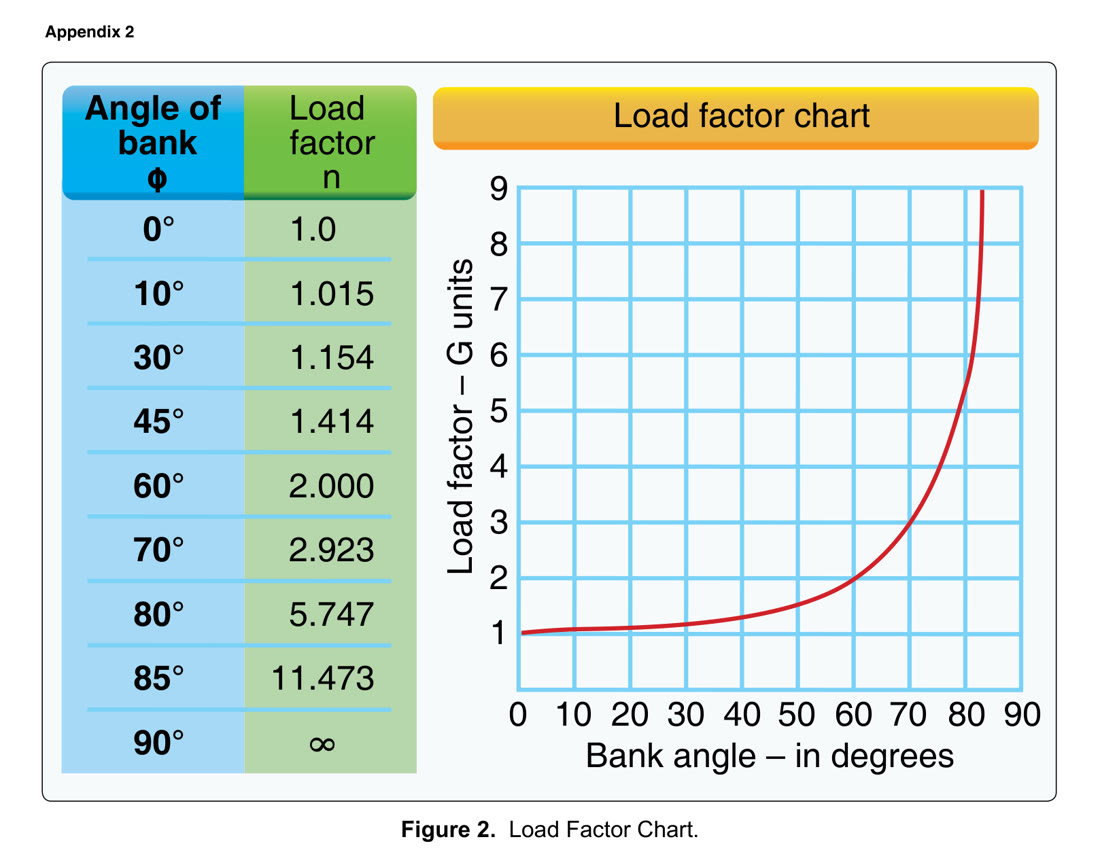
| Bank angle | 0° | 10° | 30° | 45° | 60° | 70° | 80° | 85° |
|---|---|---|---|---|---|---|---|---|
| Load factor | 1.0 | 1.015 | 1.154 | 1.414 | 2.0 | 2.923 | 5.747 | 11.473 |
The method: three steps
- Find the bank angle in the question.
- Read its load factor from the table.
- Multiply the aircraft's weight by the load factor.
Example 1: the classic
An unmanned airplane weighs 33 pounds. About how much weight must its structure support in a level 30° banked turn?
30° gives 1.154. 33 × 1.154 = 38.08. The answer is about 38 pounds.
Example 2: the easy one
A 20-pound unmanned airplane makes a level turn at 60° of bank. What load must its structure support?
60° gives 2.0. 20 × 2 = 40 pounds.
Stall speed: the square-root rule
A wing stalls when its angle of attack gets too high, and it can do that at any airspeed. In a turn, the wing has to work harder, so it reaches that angle at a higher speed. The stall speed increases with the square root of the load factor:
new stall speed = level stall speed × √(load factor)
Example 3
An aircraft stalls at 50 knots in level flight. At about what speed could it stall in a maneuver producing 4 G?
√4 = 2, and 50 × 2 = 100 knots. The tempting wrong answer is 200 knots, from multiplying by 4 instead of its square root.
Example 4
The same aircraft in a 60° bank: the load factor is 2, and √2 ≈ 1.41, so it stalls at about 50 × 1.41 ≈ 71 knots, 41% faster than in level flight.
Mistakes that cost points
- Adding instead of multiplying. 33 pounds at 1.154 is not 34.154 pounds.
- Multiplying stall speed by the load factor. Use the square root.
- Reading the wrong row. The table jumps from 45° to 60°. For an angle it doesn't list, read the curve next to it instead of guessing between rows.
- Forgetting it applies to multirotors too. Any maneuver that loads the structure, including sharp pull-ups and turns, raises the load factor.
Check yourself
Six questions, four of them on Figure 2:
| Bank angle | Load factor (G) |
|---|---|
| 0° | 1 |
| 10° | 1.015 |
| 30° | 1.154 |
| 45° | 1.414 |
| 60° | 2 |
| 70° | 2.923 |
| 80° | 5.747 |
| 85° | 11.473 |
| 90° | Not possible in level flight |
(Refer to Figure 2.) If an unmanned airplane weighs 33 pounds, about how much weight must its structure support during a 30° banked turn while maintaining altitude?
- A34 pounds
- B38 pounds
- C47 pounds
Show answer
B. 38 pounds
The load factor at 30° of bank is 1.154. Multiply by the weight: 33 × 1.154 ≈ 38 pounds.
Source: FAA-CT-8080-2H, Figure 2; Remote Pilot Study Guide, Ch. 4
(Refer to Figure 2.) A 20-pound unmanned airplane makes a level turn at 60° of bank. What load must its structure support?
- A20 pounds
- B30 pounds
- C40 pounds
Show answer
C. 40 pounds
In a level 60° bank the load factor is 2.0 Gs, so the structure supports 20 × 2 = 40 pounds.
Source: FAA-CT-8080-2H, Figure 2; Remote Pilot Study Guide, Ch. 4
(Refer to Figure 2.) About what load does a 10-pound unmanned airplane's structure carry in a level 45° banked turn?
- A10 pounds
- B14 pounds
- C20 pounds
Show answer
B. 14 pounds
The load factor at 45° is 1.414, so 10 × 1.414 ≈ 14 pounds.
Source: FAA-CT-8080-2H, Figure 2
(Refer to Figure 2.) A 5-pound unmanned airplane is flown in a level 70° banked turn. What load is imposed on its structure?
- AAbout 7 pounds
- BAbout 10 pounds
- CAbout 15 pounds
Show answer
C. About 15 pounds
The load factor at 70° is 2.923, so 5 × 2.923 ≈ 14.6, or about 15 pounds.
Source: FAA-CT-8080-2H, Figure 2
An aircraft stalls at 50 knots in level flight. At about what speed could it stall in a maneuver producing 4 Gs?
- A100 knots
- B200 knots
- C54 knots
Show answer
A. 100 knots
Stall speed increases in proportion to the square root of the load factor. The square root of 4 is 2, so 50 × 2 = 100 knots.
Source: Remote Pilot Study Guide, Ch. 4
How does load factor change as bank angle increases in a level turn?
- AIt increases slowly and evenly at all bank angles
- BIt increases at a rapidly accelerating rate beyond about 45° to 50° of bank
- CIt decreases after 60° of bank
Show answer
B. It increases at a rapidly accelerating rate beyond about 45° to 50° of bank
Load factor rises gradually at first and then very rapidly past 45°–50°: 2 Gs at 60°, about 5.75 Gs at 80°, approaching infinity near 90°.
Source: Remote Pilot Study Guide, Ch. 4; FAA-CT-8080-2H, Figure 2
Every loading question in the app comes with Figure 2. Plus weight and balance, density altitude and the rest of the 460-question bank.
Sources
- FAA Airman Knowledge Testing Supplement (FAA-CT-8080-2H), Figure 2
- Remote Pilot Study Guide (FAA-G-8082-22), Chapter 5
- Pilot's Handbook of Aeronautical Knowledge (FAA-H-8083-25), Chapter 5
Figure 2 is reproduced from the FAA Airman Knowledge Testing Supplement, a U.S. Government publication. Part 107 Test is not affiliated with the FAA.